I Mapped 20+ AI Visibility Tools. Here's What None of Them Do for Small Business Owners.
Everywhere I walk in and say I'm doing AI SEO, people look at me and say there are so many out there - visibility, AEO, SEO, marketing, consultants. I know I worked very hard building the product, but I honestly didn't know where I stood. So I ran a benchmark: mapped the market, then asked the same AI engines to rank the tools neutrally against a set of owner-facing criteria.
One note on how to read this. Companies change prices constantly, so I don't quote them. Price tiers are relative to Connect-I at $20 a month, and everything below describes the market on the study date above.
Why this market matters right now
AI assistants became a mainstream way people find local businesses. In February 2026, 45% of US consumers said they had used an AI tool for local business recommendations, up from 6% a year earlier (BrightLocal, Feb 2026). Nearly two in three of those users trust the recommendations (BrightLocal, Feb 2026).
But businesses are far behind. One 2026 study of about 350,000 business locations found ChatGPT recommended only 1.2% of them, while 35.9% showed up in Google's local results (SOCi, 2026). Getting recommended by an AI is roughly 30 times harder than ranking in traditional local search (SOCi, 2026). And AI answers are noisy: re-running the same local search gives you a list that overlaps only 20 to 33% with the last run (BrightLocal, Sept 2026). A single snapshot means nothing. Ongoing measurement is the whole game. That is why in Connect-I, we have given you a tool to measure-fix-measure, and the saga continues until you climb the visibility chain.
Money noticed. The GEO software market is estimated at about $1.09 billion in 2026, growing fast (Dimension Market Research, 2026). Startups built purely for AI search visibility have raised $472 million in venture funding, most of it in one company (Dealroom, 2026). That funding is not aimed at small businesses. It pays for enterprise-grade infrastructure - running millions of prompts, security certifications, API platforms - and the sales teams selling to large brands' marketing departments. Consolidation is underway too: a major content-management company acquired an AI visibility startup, and one leading platform killed its self-serve plans in September 2026 to go enterprise-only.
The four kinds of players
1. The old SEO suites, with AI features bolted on
These are the big, long-established SEO tool companies. They added AI tracking to their existing products: powerful software built for marketing professionals, priced around $100 to $300 a month, where the company holds the method and you rent a login.
2. The new AI visibility startups
These are newer companies built only to track how businesses appear in AI answers. They sell dashboards and subscriptions to marketing teams and agencies, and the business owner never holds the measurement themselves.
3. Done-for-you audit services
These companies start with a free automated check of your business, then sell you a deeper paid audit, then a monthly retainer where their expert does the work for you. You get reports and phone calls; the expert keeps the method and the data.
4. Traditional SEO consultants and agencies
Hired experts who handle your SEO for you, usually charging $500 to $3,000 a month (Ahrefs, SE Ranking, Backlink surveys). You get a monthly report and a call, and when you stop paying, everything stops - including the measurement. If you think your site is already doing SEO, it may be worthwhile to run your own measurement with Connect-I and see how effective it is.
The empty quadrant
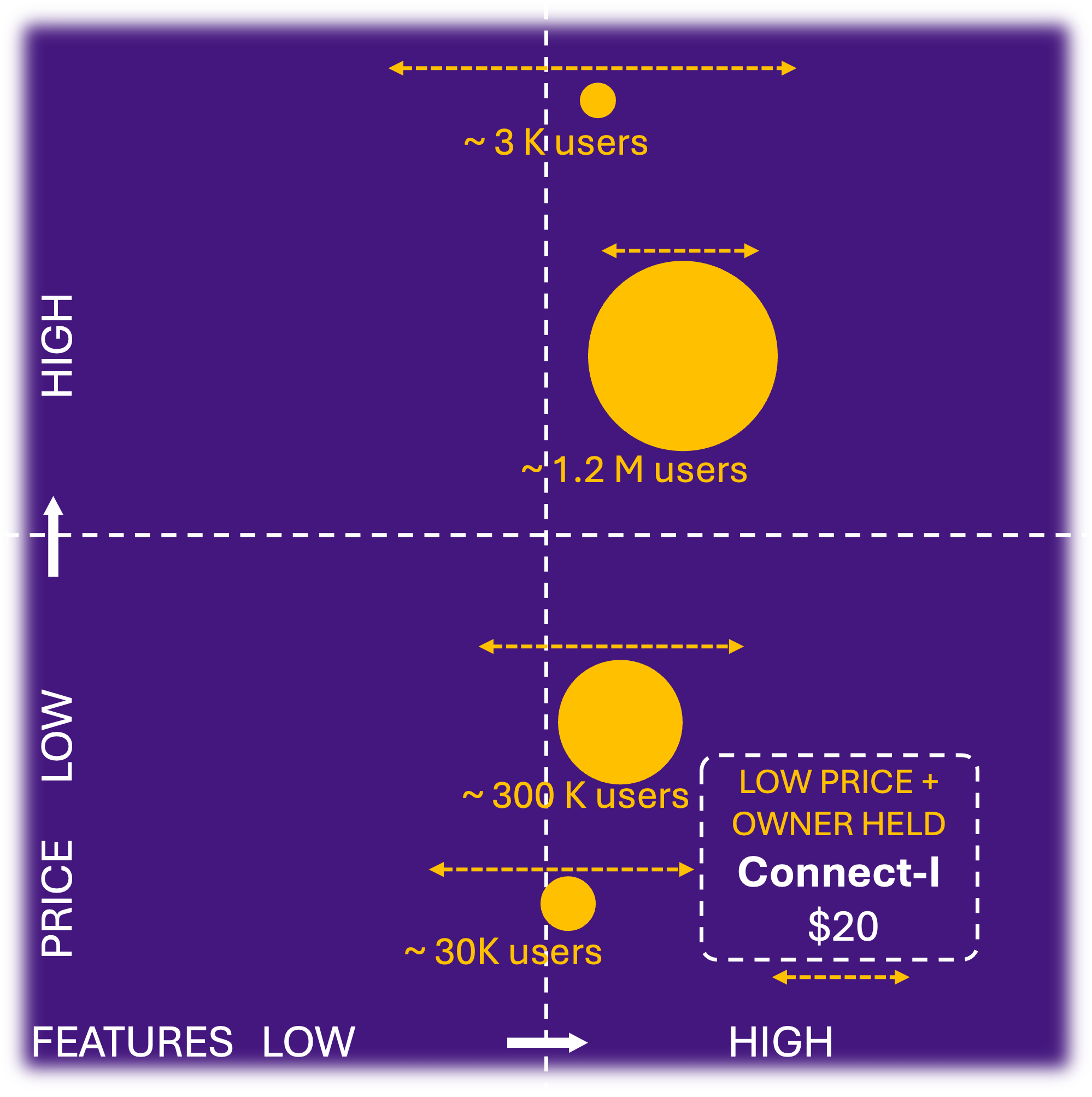
The plot shows price against feature coverage. Each dot is one archetype, sized by user base, positioned by its average feature score across four independent assessments with variations listed by dash on top.
Connect-I sits at low price plus the full owner-relevant set: lower right. Measure, improve, private, and human, on the owner's own phone, at $20 a month.
The three gaps
1. The measurement belongs to the owner, on their own phone.
Every competitor is a desktop dashboard for marketers or a PDF from an expert. No mobile app puts an AI visibility score in a non-technical owner's pocket, across ChatGPT, Claude, Perplexity, and Google, with no prompt engineering and no dashboard literacy required.
2. A deliberate measure, fix, remeasure loop at a small-business price.
The category sells endless tracking subscriptions, where noisy numbers move opaquely, or expert retainers where the owner waits for the monthly report. A first-score-free, 15 concrete recommendations, remeasure-button loop for $20 a month turns the category's core anxiety, moving numbers, into the product mechanic.
3. In-person education as the way in.
Competitors acquire through self-serve signups, content marketing, or enterprise sales. None of the tools we scored teaches non-technical owners face to face. Free two-hour hands-on workshops through trusted local partners match how established owners actually buy: in person, through people they trust. Downloading an app doesn't raise your score. It's a process, and the class teaches the process.
What "private" means, precisely
Two of the models that scored this study flagged our privacy claim as self-declared. They're right, so here's the precise version.
What leaves your phone. Two measurements, two data flows. The visibility check sends your public business profile - name, bio, website - as plain text to the AI engines, because they can't judge your authority or your core business without knowing whose business they're looking at. Inside that check sits the neutral search, which runs unbiased: only your business category and geographic location go out, no name. Your overall score is the authority score (neutral search included) plus your core business score. Everything that comes back - your score, your 15 recommendations, your AI chats - is encrypted and only you hold the key.
What we collect and why. Your name and email for sign-in. Coarse location for the radius measurement. Photos only if you add them. We don't collect phone numbers. That's the full list behind the App Store privacy labels.
On "zero-knowledge." The term applies to networking - chat, notes, cards, contacts - which is end-to-end encrypted. It doesn't apply to AI visibility, because your profile must be readable by AI engines to be measured. What's private is everything measured.
How the scores were checked
I created 16 criteria based on what I thought an end user would use, drawn from my interactions with customers in the Detroit metro region. I sent those criteria to four AI engines - Muse, Claude, ChatGPT, and Grok - and asked them to rank five tools head to head.
When the results came back, I could not believe my eyes: Connect-I ranked #1. I assumed something must be wrong with my prompt, so I asked Claude whether this is really how a customer would choose their SEO tool. Its answer was honest: the list leans toward Connect-I's strengths, which is why it ranked first. For positioning to small business owners, it said, lead with outcomes in their language - "Do AI assistants recommend me? What do I fix first? Is it working?" - and let the technical features become the proof underneath rather than the headline.
Claude offered: "If you want, I can rework the list into 10-12 owner-facing criteria and rescore the five tools on them." It came back with 12 customer-facing criteria, reframing the technical list into questions owners actually ask and adding three the original list never hand: clear price, a free first look, and a locals basics.
So we scored it twice. First, in the owner's language: the questions a non-technical business owner actually asks. Do AI assistants recommend me? What do I fix first? Is it working? Twelve criteria, scored independently by two assessors:
- Simple "am I showing up?" score
- Covers the AI engines customers use
- Measures my local area
- Tells me what to fix first
- Someone or something does the fixing
- Shows whether it's working
- Easy to use solo, non-technical
- Works on my phone
- Clear, small-business price
- Free first look or trial
- Local basics (Google, reviews)
- Human help or training
| Tool | Muse | Claude | Average |
|---|---|---|---|
| Connect-I | 10 | 10.5 | 10.25 |
| A (~1.2 M users): legacy suite AI add-on | 8.5 | 8 | 8.25 |
| B (~3K brands): enterprise GEO platform | 7.5 | 7.5 | 7.5 |
| C (~30K users): budget self-serve tracker | 8.5 | 8.5 | 8.5 |
| D (~300K users): marketing-suite add-on | 8.5 | 8.5 | 8.5 |
Yes = 1, Partial = 0.5, No = 0, Uncertain = 0, out of 12. The two assessors agreed on nearly every cell; the one difference was the legacy suite's phone score, which Claude left as Uncertain. Two honest notes. "Human help" counts everyone's academy and onboarding equally; in-person local workshops are a different thing, and only one tool here does those. And "someone does the fixing" is nobody's strength - no product here implements fixes for you. Our answer to that row is the partner network: local partners who implement the recommendations at their own fees. That's a business model, not a product feature, so we don't score it.
The technical proof underneath
Beneath the owner's twelve questions sits the technical scoring: 16 features in four categories, assessed four independent ways. The 16 criteria:
- Measure - neutral search sessions, visibility score, website score, multi-engine coverage, location.
- Improve - recommendations, done-for-you implementation, keyword tracking, backlink data, competitor comparison, remeasure over time.
- Private - data privacy, private AI chat, mobile app.
- Human - solo non-technical use, human-led workshops.
| Tool | Muse | ChatGPT | Grok | Claude | Average |
|---|---|---|---|---|---|
| Connect-I | 13.5 | 11 | 13.5 | 12.5 | 12.6 ± 1.2 |
| A (~1.2 M users): legacy suite AI add-on | 9.5 | 11.5 | 11.25 | 10.5 | 10.7 ± 0.9 |
| B (~3K brands): enterprise GEO platform | 6 | 13 | 12.75 | 9.5 | 10.3 ± 3.3 |
| C (~30K users): budget self-serve tracker | 7 | 9.5 | 11.75 | 11 | 9.8 ± 2.1 |
| D (~300K users): marketing-suite add-on | 5.5 | 7.5 | 10.25 | 9 | 8.1 ± 2.0 |
Yes = 1, Partial = 0.5, No = 0, out of 16. "Muse" is my AI assistant's independent scoring against vendor docs and reviews. The AI models scored from public documentation (for Connect-I, that meant my App Store listing and screenshots); all three share a bias toward well-documented companies, and four assessments is directional rather than rigorous statistics. Where all four agree, the score is solid: Connect-I finishes first in three of the four, and last place is unanimous. Tool B's ±3.3 spread is the honest disagreement - strict evidence standards versus training-data knowledge. We name no vendors in this post; the named working table is available to reviewers on request.
One note on scope: the models scored five tools we supplied. This test analyzes content, not discovery, which is a separate subject since search engines take time to crawl.
Footnote: mobile apps checked
We checked the App Store on October 31, 2026 for mobile apps in this space. Two results were traditional SEO helpers, not AI visibility tools. The closest mobile adjacent was a rank tracker with a feature showing what two AI engines say about a site. But it needs a website URL to start, targets webmasters and SEOs, and has no remeasure loop, no education layer, no radius view, and no privacy story. The gap stands.
How this study was made
Based on publicly listed information as of 31 October 2026: vendor pricing and feature pages read live, plus third-party reviews and roundups from 2026. Anything we couldn't verify is marked as such in our working notes. Tiers describe the market on the study date; companies change prices, which is why we use relative tiers instead of quoting figures. If something here is outdated or wrong, tell us at nityvision@gmail.com and we'll correct it.
See where you stand.
Your first AI visibility audit and score is free. Measure it, get your 15 fixes, remeasure when the work is done.
Run your free score